Reading • Membership decision guide
Audible Premium Plus Annual: Is It Worth It?
As an Amazon Associate, BestPickZone earns from qualifying purchases. We may also earn a bounty from eligible sign-ups through our affiliate links, at no extra cost to you.
By BestPickZone • Published October 3, 2026 • U.S. programs • Researched editorial guidance
Audible Premium Plus annual membership is best suited to an established audiobook listener who wants credits available upfront and expects to choose enough books to justify a year of membership. It is a poor first experiment for someone still discovering whether they enjoy audio. The annual price matters, but so do credit deadlines, existing unread purchases, and whether the books you want are cheaper through another route.
Affiliate link. Check the exact plan, eligibility, current price, and renewal terms on Amazon before signing up. Trial availability is not guaranteed.
What makes the annual plan different?
Audible's credit-based Premium plans let members use credits to purchase eligible audiobooks. Its help center describes annual options with 12 or 24 credits provided upfront. Confirm the exact annual option, price, and credit count on Amazon's signup page; an annual plan is not simply twelve independently cancellable monthly purchases.
The upfront allocation can suit someone who wants several books immediately, such as a long series or a set of listening choices for travel. It is less helpful if you already have a backlog. Receiving more credits does not create more listening time, and unspent credits should not be treated like cash in a savings account.
See Audible's credit rules for expiration details. The rules can vary by how credits were issued. For a membership purchased through Amazon or the web, pay particular attention to expiration and the effect of cancellation; do not assume app-store exceptions apply.
How do you compare the annual cost fairly?
Divide the total annual charge by the number of credits in the exact offer, then compare that figure with the cash prices of books you genuinely want. This is a planning tool, not the complete value calculation, because the membership may include other benefits and you may not use every credit.
For illustration only, an annual offer costing $150 with 12 credits would imply $12.50 per credit. If you use only eight before losing or wasting the rest, the effective cost per useful selection becomes $18.75. Neither figure is a current advertised Audible price; the example shows why usage matters as much as the headline discount.
Now make a shortlist of actual titles. Check their cash prices, your library's availability, and whether they are currently included in a membership catalog. Spending a credit on a low-priced short audiobook may be a weak use of an expensive allocation. On the other hand, length alone is not value: a shorter book you love can be a better purchase than a long one you abandon.
How many books will you realistically finish?
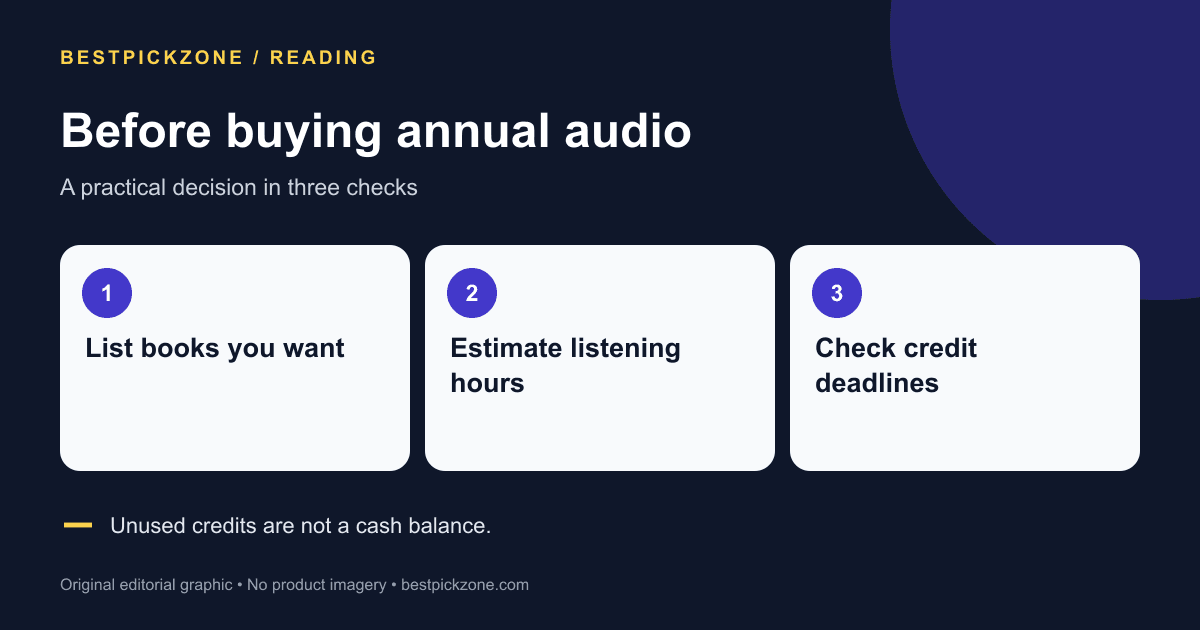
Estimate listening capacity from a normal week rather than an ambitious future routine. Commutes, walks, chores, and exercise can create regular listening time, but only count periods when audio is practical and enjoyable. A plan that depends on replacing all music and podcasts may overestimate demand.
At three hours per week, a listener has roughly twelve hours in a four-week month. A twelve-hour audiobook could occupy nearly that entire allowance at its recorded speed. A forty-hour fantasy installment could occupy several months. Playback speed changes the arithmetic, but do not base the purchase on a speed you find tiring.
Check your existing library before enrolling. List unfinished purchased books, library holds, and podcasts you already follow. If that queue covers the next several months, using it first may be more valuable than adding an annual commitment. Our reader-picks hub can help identify a focused next read without encouraging an oversized backlog.
What do you keep if membership ends?
Audiobooks purchased with credits or money remain associated with your account after membership ends, while access to included subscription titles is different. Do not confuse a book downloaded from an included catalog with a book you purchased. Check the acquisition type in your library before deciding what will remain available.
Audible's cancellation guidance explains the loss of member benefits and unused credits at the applicable end of the billing cycle. Review your credit summary and the cancellation confirmation rather than relying on a blanket assumption about immediate or delayed access.
If keeping particular books matters, make deliberate selections before the relevant deadline. Do not rush into twelve unfamiliar books merely to avoid expiration. The better prevention is choosing an allocation you can use thoughtfully and setting reminders while there is still time to listen to samples.
How should you choose the first few audiobooks?
Sample the narrator before spending a credit. Familiarity with a printed book does not guarantee that you will enjoy its audio production. Pace, accents, ensemble casting, and the handling of footnotes or diagrams can affect whether audio is the right format.
For nonfiction with exercises, tables, or detailed reference material, check whether companion material is provided and whether you will actually use it. A book that you need to consult repeatedly may work better in print or digital text. For fiction, check whether the edition is abridged, its language, and its place in the series.
Build a three-book starting list: one dependable choice, one book whose narration is especially appealing to you, and one shorter selection that fits a busy week. This is more useful than spending every credit immediately. Upfront availability is flexibility, not an instruction to empty the balance on signup day.
When is a monthly plan or Standard a better fit?
A monthly plan is often better when your listening habit is unproven, your schedule will change, or you prefer a smaller recurring commitment. Compare the cost and terms of the exact offers. Annual membership can be efficient for consistent use, but it concentrates the purchase decision into one larger payment.
Audible Standard uses a different model: a monthly selection available while membership remains active, rather than the same keep-after-cancellation credit purchase. Our Standard trial guide explains that distinction. Choose based on whether you want access for now or a purchased listening library, not only on the cheapest starting price.
If you are buying for someone else, use our 12-month gift membership guide. A gift has different renewal and redemption considerations, especially when the recipient already subscribes. Do not buy a personal annual plan as a workaround for a gift without checking the proper gift process.
What should you check immediately before purchase?
Confirm the plan name, annual charge, renewal terms, credit count, marketplace, and account. Save the confirmation and set reminders for credit deadlines and the next billing date. If a promotion is shown, distinguish the introductory charge from the renewal charge.
Start here: write a realistic listening schedule and a shortlist of books, then compare the annual offer with monthly membership and individual purchases. Skip this first: a large annual allocation bought mainly because the per-credit figure looks attractive. Annual Premium Plus makes the strongest sense when the listening habit already exists and the membership serves it.
Affiliate link. Check the exact plan, eligibility, current price, and renewal terms on Amazon before signing up. Trial availability is not guaranteed.