Prime • Membership decision guide
Prime for Young Adults Trial: Who Should Try It?
As an Amazon Associate, BestPickZone earns from qualifying purchases. We may also earn a bounty from eligible sign-ups through our affiliate links, at no extra cost to you.
By BestPickZone • Published October 3, 2026 • U.S. programs • Researched editorial guidance
Prime for Young Adults is worth checking before standard Prime if you are an eligible 18-to-24-year-old or higher-education student. Its appeal is a longer opportunity to test the service and a lower subsequent membership price. The catch is that eligibility must be verified, the offer is account-specific, and a discounted subscription still needs to earn its place in your budget.
Affiliate link. Check the exact plan, eligibility, current price, and renewal terms on Amazon before signing up. Trial availability is not guaranteed.
Who is this trial designed for?
Amazon describes the U.S. program as serving young adults aged 18–24 and higher-education students, including qualifying students outside that age range. It advertises a six-month trial for eligible new members, followed by discounted membership. Check the official membership overview and the offer displayed during enrollment for current terms.
The important distinction is between qualifying for the membership category and qualifying for a particular introductory offer. Having the right age or student status does not by itself prove that your account can receive another trial. A prior membership, promotion, or verification issue can change what is available. Read the final enrollment screen rather than relying on a friend's experience.
Prepare whatever age or student verification Amazon requests. Submit that information only through Amazon's own secure enrollment process. BestPickZone does not verify eligibility, need a copy of your documents, or collect your date of birth. If your account is rejected unexpectedly, use Amazon support rather than changing details to force an approval.
When is a longer trial actually useful?
A longer trial is useful when it includes ordinary routines, not just a burst of move-in purchases. Test delivery at the address you will use, entertainment during a normal week, and whether the service reduces the effort of necessary shopping. A dorm setup weekend alone can make almost any shopping membership look more valuable than it will be later.
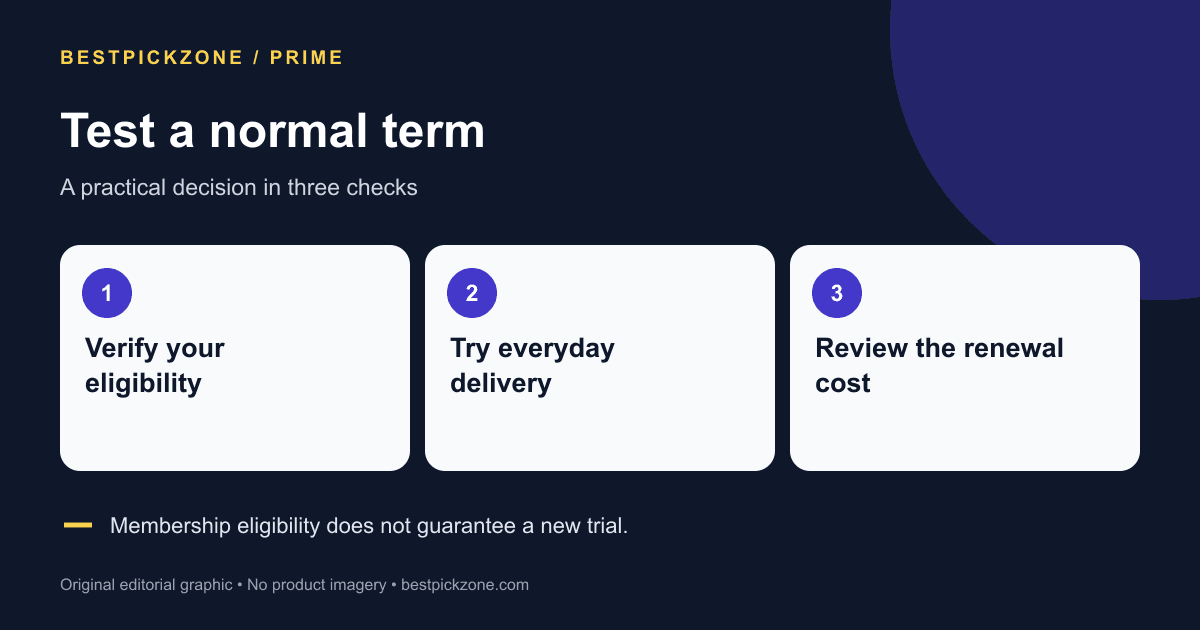
Divide the trial into three checkpoints. At the beginning, record the terms and make a list of expected uses. Around the middle, review what you actually used without changing your spending to fit the service. Before the end, decide whether the recurring price is justified by that record.
For a student moving away from home, the first checkpoint might include bedding, a desk lamp, and practical storage. Our dorm-room essentials guide can help narrow that list. The second checkpoint should look different: replacement toiletries, an occasional book, or an included show. This separates a temporary shopping project from a continuing need.
How should students test delivery benefits?
Test delivery against your campus or building's actual receiving rules. An item reaching the campus mailroom is not necessarily the same as an item reaching your room. Package processing times, limited pickup hours, and holiday closures can matter more than the shipping speed displayed on the product page.
Check the exact address format your institution requires. For a large purchase, confirm storage and collection arrangements before ordering. A mini fridge delivered during a break is a problem even if shipping itself is fast. Avoid setting up recurring deliveries to an address you will leave at the end of term.
For younger adults living at home, compare the incremental value with arrangements already available to the household. Do not assume that another person's membership can be shared under every circumstance; check Amazon's current household rules. The relevant question is what your own enrollment adds, not how many different Prime accounts your household can accumulate.
Which costs can hide behind a membership benefit?
The membership price is only one part of the decision. Purchases, rentals, additional channel subscriptions, food orders, and optional service upgrades can still cost money. A benefit that makes it easier to spend is useful only if the underlying purchase fits your budget.
Use a simple two-column note. In one column, record a benefit you used; in the other, record the spending it caused or replaced. Watching an included movie instead of renting one may replace a cost. Ordering a late-night meal because delivery feels easier may add a cost. Both experiences can be enjoyable, but they should not be counted as the same kind of saving.
For coursework, check the required edition and format before buying textbooks or digital books. Prime membership does not make every textbook free, and an ordinary Kindle edition may not include a course access code. A used physical copy, campus reserve, or library loan may still be the better choice.
How do you judge the renewal price fairly?
Judge the discounted price against your own use, not only against full-price Prime. Check the current monthly and annual fees after any eligible trial on the enrollment page. A lower price is helpful, but a subscription you rarely use is still an expense.
As an illustrative planning exercise, a hypothetical $60 annual fee spread over twelve months is $5 per month. This is not a current Prime price. That calculation does not make the annual plan risk-free: the money is committed upfront, and your needs may change after graduation, a move, or a new job. Monthly billing can be preferable when the next year is uncertain, even if its annualized total is higher.
Avoid double-counting entertainment. If you already intend to keep another streaming service, Prime Video's existence is not automatically equivalent to saving that subscription's full price. Count replacement value only when you actually cancel or avoid the alternative. For a broader decision framework, see our paid Prime membership analysis.
What happens when your circumstances change?
Review your membership when you graduate, move, change schools, or approach the age limits relevant to your enrollment. Amazon determines ongoing eligibility and any verification requirements. Keep your account information current and review notices about the membership price rather than assuming the introductory terms last indefinitely.
Set a calendar reminder before the trial ends as soon as you sign up. If your school term ends first, add an earlier review for your shipping address and saved payment method. A trial can span a move, which makes it particularly easy to lose track of deliveries or billing notices.
Cancel through the membership management process if you decide against renewal, and check the effective end date Amazon shows. Save the confirmation. Do not leave cancellation until the last few minutes before the deadline, especially if verification or login problems have already affected the account.
Should you use it before a major shopping event?
It can be convenient to evaluate the program before Prime Day if you already need eligible items, but do not make a sale the only reason to enroll. Our Prime Day trial timing guide explains how to put an event inside the offered trial window without assuming every product will be discounted.
Start here: check eligibility, save the renewal terms, and run the trial through several ordinary weeks. Skip this first: a paid commitment justified by occasional perks you probably will not use. If the trial confirms useful delivery and entertainment at a sustainable price, the membership has a clear role. If it mainly creates extra shopping, keeping the money is the better student discount.
Affiliate link. Check the exact plan, eligibility, current price, and renewal terms on Amazon before signing up. Trial availability is not guaranteed.