Prime • Membership decision guide
Is Paid Amazon Prime Worth It? Monthly vs Annual
As an Amazon Associate, BestPickZone earns from qualifying purchases. We may also earn a bounty from eligible sign-ups through our affiliate links, at no extra cost to you.
By BestPickZone • Published October 3, 2026 • U.S. programs • Researched editorial guidance
A paid Amazon Prime membership is worth considering when its delivery and included entertainment benefits reliably replace costs or inconvenience you already have. It is harder to justify for occasional shoppers who can wait for ordinary shipping and do not use the other benefits. Decide from a normal month of activity, then choose monthly or annual billing based on how certain you are that the use will continue.
Affiliate link. Check the exact plan, eligibility, current price, and renewal terms on Amazon before signing up. Trial availability is not guaranteed.
What are you paying for?
Prime bundles eligible delivery benefits, member offers, and entertainment benefits. Check the current monthly and annual fees and the terms shown on your account before purchasing.
The official benefits overview is useful for checking what is included. The relevant word is included: rentals, additional channel subscriptions, and optional service upgrades can be separate purchases. A tile appearing inside an Amazon service does not mean your Prime membership pays for it.
Do not value every listed benefit at its hypothetical standalone price. If you would not buy that service separately or use it regularly, assigning it a large dollar value makes the membership look better without improving your life. Start with two or three benefits you can identify from your own habits.
Is monthly or annual billing better?
Annual billing can cost less when you are confident that you will use Prime throughout the year. Monthly billing gives you more flexibility when you need the service for a limited period or are still evaluating it. A lower annualized price is not necessarily the better choice if your needs are temporary.
Multiply the current monthly fee by the number of months you expect to use Prime and compare that total with the current annual fee. This calculation does not establish refund rights or guarantee that stopping and restarting will qualify for promotions.
For a move, a short home project, or a seasonal shopping period, a single month might match your needs better than a year. For a household with consistent eligible deliveries and regular use of included entertainment, annual billing may be easier to justify. Check cancellation and refund terms before committing; do not assume unused months can always be recovered.
How much are shipping benefits really worth?
Shipping benefits are worth the costs and friction they actually remove. Compare Prime with what you would realistically do without it: combine orders, wait longer, collect locally, or buy from another retailer. Counting an avoided express charge on every parcel exaggerates value if you would never have paid for express delivery.
Review your last several orders. Mark each one as urgent, convenient, or easily delayed. For the urgent orders, ask whether Prime's displayed delivery estimate truly solved the timing problem. For the others, estimate whether an ordinary free-shipping threshold or a different retailer would have worked.
Location matters. Check your address on representative listings rather than assuming an advertised service speed applies everywhere. Delivery to an apartment parcel room or campus mailroom may add another collection step. A membership can still be useful, but the practical benefit should be measured at the point you receive the item.
For equipment purchases, quality and compatibility remain more important than shipping speed. Our home and kitchen guides and technology guides can help define the right product before you compare retailers.
Can entertainment alone justify Prime?
Entertainment can be part of the case when you regularly use included content and it replaces another expense. It is a weak justification when you mainly rent separately priced titles or keep every other streaming subscription unchanged. Choose specific things you want to watch or use, then check their inclusion.
For example, if an included show replaces a streaming service you actually cancel, count the expense you stop paying. If you merely add Prime to three existing services, treat it as an additional entertainment choice rather than a saving. That may still be worth buying, but the decision should be honest about the cost.
Books require similar care. Prime reading benefits are not the same as a full Kindle Unlimited subscription, and Audible membership is another separate choice. A reader primarily interested in a larger borrowing catalog should compare our Kindle Unlimited evaluation. A listener who wants to retain purchased audiobooks should examine the Audible annual-plan guide.
How should you value shopping-event access?
Treat access to member offers as an opportunity to compare prices, not as guaranteed annual savings. The products you need may not be discounted, and a competing retailer may offer a better total price. A membership should not pressure you to manufacture purchases just to recover its fee.
Write down planned purchases and target prices before the event. Use the exact model, size, and configuration, and include required accessories in the total. If the offer fails that test, keep waiting. Our Prime Day preparation guide explains the same process for eligible trial users.
One expensive purchase can produce a meaningful saving, but verify it before treating it as evidence for a recurring commitment. A one-time difference does not automatically justify next year's membership. Review Prime again when the annual renewal approaches rather than assuming the original purchase will keep paying for it.
What does a realistic value worksheet look like?
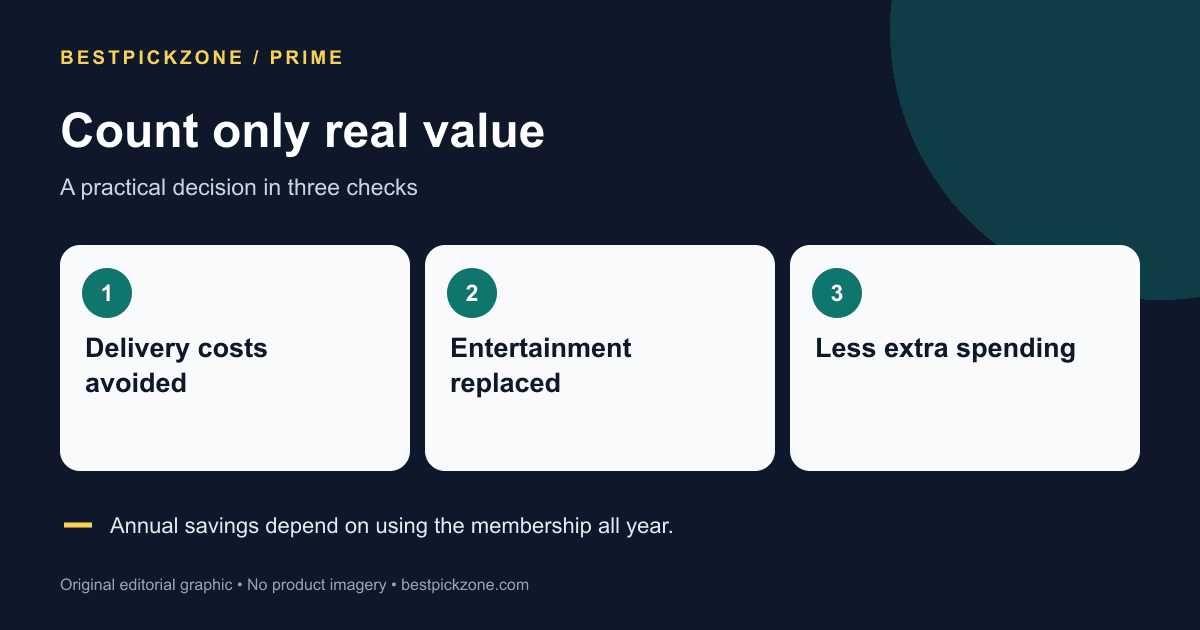
Use four lines: delivery expenses genuinely avoided, entertainment expenses actually replaced, convenience you willingly pay for, and extra spending encouraged by the membership. Subtract the last line rather than overlooking it. Keeping those categories separate makes the calculation understandable.
Suppose a household avoids $6 in actual shipping charges and replaces an $8 entertainment expense during a month. Its measurable replacement value is $14. Against a hypothetical $15 monthly fee, the remaining justification must come from convenience or other real use. This example does not predict your results; it shows why rounding every benefit upward can conceal a weak purchase.
Do the same calculation for a low-use month. If the membership works only during a holiday shopping surge, monthly billing or no membership may fit better. If it remains useful during the quiet months, the annual option becomes more credible.
Which membership should you check before paying full price?
Review Prime for Young Adults or Prime Access if you may qualify. Amazon verifies eligibility and determines the offer available. Do not pay the standard price simply because it is the first signup button you see.
Start here: review recent orders, name the included services you use, and choose a billing period that matches your certainty. Skip this first: an annual commitment based on imagined future shopping. Paid Prime can be a useful household service, but the strongest reason to keep it is repeated demonstrated value, not a long benefits list or a sale countdown.
Affiliate link. Check the exact plan, eligibility, current price, and renewal terms on Amazon before signing up. Trial availability is not guaranteed.