Model-specific buying guide
Gaggia Classic Pro Upgrades: Buy for the Exact Revision
For a Gaggia Classic Pro owner, start with a suitable grinder, a usable scale and a repeatable recipe before buying internal modifications. Keep the supplied parts that already work. The best next purchase addresses a problem you can name: an unadjustable grind, no way to weigh the drink, an uncomfortable tamper or a verified fit limitation. It is not automatically a PID kit, pressure spring or replacement steam wand.
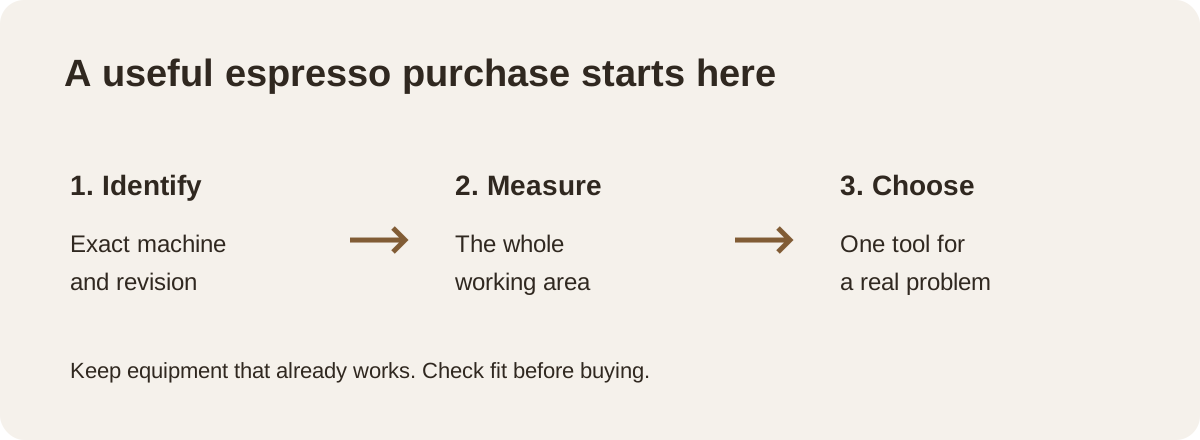
First identify whether you own an older Classic, Classic Pro, Evo or E24. The current US E24 specification cannot be assigned to every machine carrying the Classic name. Record the model label and electrical version, then use the corresponding Gaggia manual. That step prevents an upgrade list written for a different revision from becoming your shopping cart.
Which problem should you solve first?
Make a few drinks with the equipment you have and record the coffee dose, drink weight, approximate time and what you dislike. Keep the same beans and basket while doing this. If those inputs vary unnoticed, buying a new basket and changing pressure at the same time makes it difficult to learn which change helped.
If coffee rushes through despite the available grinder adjustments, investigate the grinder and preparation before assuming the machine needs modification. If your drinks are satisfactory but weighing is awkward, solve the tray and cup-clearance problem. If the steam wand is dirty or behaving unusually, follow the maintenance guidance and contact support where needed rather than disguising a fault with an aftermarket part.
Separate repair, convenience and experimentation in your budget. Replacing a worn component is not the same decision as adding a diagnostic portafilter. A convenient tool can be worth buying without a claim that it improves every cup. A hobby modification can be interesting without being necessary for ordinary ownership.
When is an Encore ESP a reasonable grinder shortlist?
The original Baratza Encore ESP (Amazon search) is a candidate when your existing grinder lacks useful espresso adjustment. Baratza identifies an espresso-focused adjustment system and included dosing cup. Choose the ESP deliberately; the standard Encore and Encore ESP Pro are different models.
It does not need to fasten to the Gaggia to work with it. Grounds can be collected and transferred to the basket, so the important questions are adjustment, handling and the space around the grinder. Check whether your preferred transfer method is tidy with the basket you actually use. Do not assume a dosing cup's presence eliminates every spill.
If you already own an espresso-capable grinder that lets you repeat your recipe, keep it. This article does not establish that an Encore ESP would improve it. For a wider comparison, see our Gaggia grinder guide; the correct choice depends on whether you prefer electric operation or are comfortable grinding each dose manually.
- Pros: a clearly identified espresso model; an external purchase that does not alter the machine.
- Cons: still requires dialing in; adds a counter footprint; not a universal upgrade over an existing grinder.
Skip this if your present grinder already does the job. Spend time documenting the recipe before replacing working equipment.
Search Amazon for this product
What makes a scale useful on the Classic's tray?
A scale is useful when it lets you weigh the drink without crowding the cup or hiding the display. The Timemore Black Mirror Nano, white (Amazon search) is one specific candidate. Its manufacturer page lists weighing, timing and side controls. Physical fit still needs checking on your machine.
Measure from the tray to the lowest point of the installed portafilter, then account for scale height and the cup. Check room for the handle and your fingers at the controls. Do this with the spouted portafilter you currently own, not an imagined future bottomless handle. A scale that fits only after another purchase may be the wrong starting point.
The Nano is not the Black Mirror Mini or Basic. Verify the selected model and seller support rather than assuming an adjacent product is equivalent. If your existing scale fits and gives a readable, repeatable measurement, there is no automatic reason to replace it with this one. Our low-profile scale guide explains the clearance decision in more detail.
Skip this if your cup blocks the display or the tray cannot support it securely. Do not buy by nominal height alone.
Search Amazon for this product
Do you need a bottomless handle, basket or tamper?
A bottomless portafilter changes access and visibility beneath the basket; it does not repair puck preparation by itself. Check the exact Gaggia revision, lug geometry, basket depth and manufacturer compatibility statement. “58mm” describes a size family, not a universal locking interface. A handle intended for another 58mm machine can still be the wrong part.
Use the supplied basket first unless it creates a specific limitation. If you later change baskets, match the intended dose, internal depth and clearance in the handle. The basket and tamper must also fit each other. A nominal 58mm tool, a 58.5mm precision tamper and different basket interiors are not interchangeable simply because the labels look close.
For a tamper purchase, prioritize a comfortable grip and verified fit over a promise that a calibrated spring guarantees better espresso. For a distribution tool, consider where it will be stored and whether it improves your actual preparation. Buy one change at a time. Our Gaggia portafilter guide provides the separate fit checks; this article does not endorse a generic search result as compatible.
Why are PID kits, pressure springs and wand swaps not first purchases?
The current US E24 page lists a brass boiler, a two-hole steam wand and a nine-bar OPV calibration. An older guide's advice to change every Classic's pressure or replace its wand therefore cannot be applied indiscriminately. Confirm what is already installed before pricing a modification.
Gaggia's E24 manual directs servicing beyond cleaning and user maintenance to authorized service personnel and warns against disassembly. Internal kits involve more than accessory fit. This guide does not provide electrical or pressure-modification instructions or promise that an aftermarket kit preserves warranty coverage. Discuss a diagnosed problem with authorized support before purchasing parts.
Start here: identify the revision, keep a recipe log, then solve the specific grinding or measurement gap. Skip this first: a universal modification bundle or several supposedly compatible 58mm accessories ordered together. The Coffee hub can help you compare individual tools once the need is clear.
Manufacturer pages and revision-specific Gaggia manuals checked October 18, 2026. This is researched purchase guidance, not hands-on testing, repair instruction or a promise of measured taste improvement.