Model-specific buying guide
Small-Kitchen Coffee Station: Measure Before You Buy
A small coffee station needs room to make and clean a drink, not just enough counter width to display the appliances. Start by choosing the coffee you will actually prepare. For an espresso-and-milk routine, the Breville Bambino Plus, original Baratza Encore ESP and Timemore Black Mirror Nano are specific candidates to assess. They are not a guaranteed under-24-inch package, and buying all three is unnecessary if your existing equipment already works.
This guide uses the US BES500 Bambino Plus as the espresso example. It does not assume the base Bambino, a different regional voltage or another manufacturer's compact machine has the same dimensions, accessories or instructions. Measure your space and check the current package before spending. No hands-on fit test of this combination is claimed.
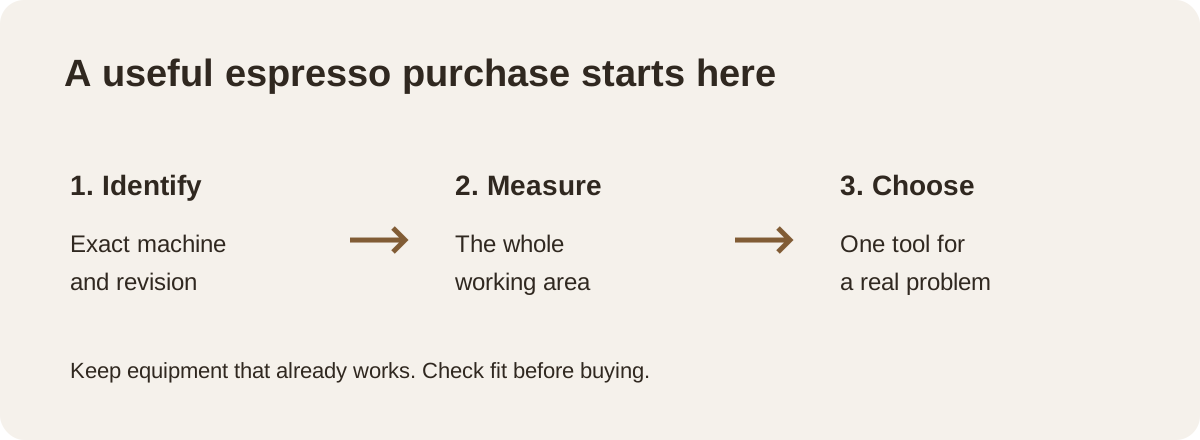
Choose a drink routine before filling the counter
If you mostly want a mug of brewed coffee, an espresso machine is not the only route to a useful station. Keep a brewer you enjoy and organize its filters, grounds and cleaning supplies. Espresso adds a separate preparation and milk workflow. That can be worthwhile when those are the drinks you want, but compact equipment does not eliminate the extra steps.
Write down one normal morning: who makes the drink, how many drinks follow, whether milk is involved, and where the used coffee goes. Then identify the current bottleneck. It might be grinding, somewhere to set a wet portafilter, or simply storage that forces you to unpack every tool. A new machine does not automatically solve any of those problems.
Set a total budget that includes the equipment you actually lack. Do not treat a machine's advertised price as the entire espresso budget if you also need a suitable grinder. Conversely, avoid replacing a functioning grinder merely to make all the items on your counter match. Our Bambino grinder guide compares different preparation workflows.
Measure four working areas
First, measure the appliance footprint on the real counter. Include the usable depth ahead of the backsplash and the space beneath upper cabinets. Do not rely on a photograph or add two published widths and call the layout finished. Product-page dimension order can be unclear; ask the manufacturer for a drawing when a tight fit depends on interpreting it correctly.
Second, check access to water and beans. Mimic removing and carrying the water tank without putting it behind another appliance. Consider how you will reach the grinder's hopper and controls. If refilling requires dragging equipment every morning, account for that movement and the counter surface before choosing the arrangement.
Third, leave a dry preparation spot for the basket, dosing cup and tamper. You need to set items down between grinding and brewing. A narrow gap that holds a tamper upright may still be too small to prepare a portafilter comfortably. Keep the workflow stable and clear of the edge rather than balancing the handle over a sink or open drawer.
Fourth, check cleanup. Pull out the drip tray, place the milk jug where the instructions require it, and trace the route to the sink or waste bin. Leave the relevant controls reachable. These are working clearances; a photograph of three neatly touching appliances does not establish that the setup is convenient to use.
Machine candidate: Breville Bambino Plus BES500
The Bambino Plus (Amazon search) is a candidate for someone who wants espresso and automatic milk texturing. Breville's US page identifies the model and supplied accessories. Check the exact region, electrical rating and package rather than ordering by the Bambino family name alone.
Read the current US/Canada manual before deciding where it belongs. Automatic milk texturing uses a temperature-sensor arrangement and the supplied stainless-steel jug. Do not plan to replace that jug with a decorative pitcher simply because the latter fits your shelf better. Keep enough room for the documented steam-wand and cleaning workflow.
Pros: a defined espresso-and-milk workflow and a supplied set of basic accessories. Cons: still requires preparation, cleaning and working space; the Plus features do not establish that it fits your cabinets. Skip this if brewed coffee meets your needs or your existing espresso machine works well.
Search Amazon for this product
Grinder candidate: original Baratza Encore ESP
The original Encore ESP (Amazon search) is a separate purchase for a fresh-bean espresso workflow. Baratza's product page describes its espresso-oriented adjustment and supplied dosing cup. The standard Encore and ESP Pro are different products; this recommendation does not transfer their specifications.
Allow somewhere to remove the grounds cup and transfer its contents. Do not assume your chosen portafilter can be mounted directly under the grinder. Place the grinder where its controls and bean access remain convenient without routing a cable across the wet cleanup area. Follow the electrical and placement instructions for both appliances rather than improvising an overloaded power-strip arrangement.
Pros: a specific grinder to investigate for espresso, with a cup-based transfer option. Cons: adds an appliance and another cleaning task; does not replace dialing in. Skip this if your current grinder already supports the coffee you make.
Search Amazon for this product
Scale candidate: Timemore Black Mirror Nano, white
The Nano White (Amazon search) is a named weight-and-timing option. Verify the dimensions on Timemore's page against the usable tray, installed spouts and your actual cup. Nano, Mini and Basic are not interchangeable model names.
A scale can fit on the tray while a tall cup on top of it does not fit beneath the portafilter. Include both heights and the space needed to insert the cup. Check that you can see the display and reach the controls without disturbing the drink. A smaller receiving cup may suit one routine; it is not a universal solution for everyone who wants to brew directly into a mug.
Pros: combines weighing and timing in one tool. Cons: clearance and control access still need checking. Skip this if your current scale is readable, stable and fits. Our low-profile scale guide covers alternatives when clearance is the constraint.
Search Amazon for this product
Store occasional tools away from the daily work area
Keep the daily basket, tamper and jug accessible; put spare baskets and maintenance supplies in a labeled location nearby. A tray can group small tools, but measure whether its raised edges obstruct preparation. Buy a knock box only if it improves disposal enough to justify its footprint. A large accessory organizer can consume more useful space than the items it organizes.
Use the station for several ordinary mornings before adding specialized accessories. Note what you repeatedly move, spill or cannot reach. Solve that observed problem first. For example, a safer preparation spot may matter more than a second portafilter, while easier access to cleaning supplies may matter more than another display shelf.
Choose this three-part shortlist when you want espresso and milk, need the equipment, and have checked the complete workflow. Skip the bundle approach when it duplicates tools or leaves no working area. See what to buy with a Bambino Plus for the next accessory decisions after the layout works.
Sources checked October 18, 2026: Breville BES500 US product page and linked manual, Baratza Encore ESP and Timemore Nano White manufacturer pages. Layout advice is planning guidance; no universal counter-width or fit guarantee is made.